Why a flying
museum?
A static museum shows an exhibit behind glass. A flying museum lets it live. A 1939 training aircraft locked in a hangar is a historical object — the same aircraft taking off from grass, with the hiss of the engine and the smell of fuel, is an encounter with history in the fullest sense of the word.
The Polish Air Force Flying Museum Foundation 1940-1947 was born from the conviction that the finest tribute to Polish airmen is to keep their aircraft flying. Not recreation — originals only. Not a description in a display case — a living engine, living wings.
Every aircraft in the collection was actually used by Polish airmen or by units in which Poles served. Each has its documented history. Each flies.
PhilosophyOriginal, not replica
The Foundation's rule is simple: original airframes only. No replicas, no reconstructions from new parts. Every aircraft must have a documented provenance and must fly in a configuration as close to the original as possible.
Tiger Moth T-7230 flies without an enclosed cockpit, without an electric starter, without modern avionics — exactly as in 1940. Harvard SP-YIX wears the colours of 602 Squadron RAF. Every detail is considered.
This is not sentiment for sentiment's sake. It is a consistent decision: if an aircraft is to tell a story, it must be authentic. Otherwise it tells the story of a replica.
To meet those men, to fly with them — it was worth all the effort, cost and responsibility of owning a warbird.
Jacek Mainka — FounderPolish aviation
in the West
After the September 1939 defeat, thousands of Polish airmen made their way West — through Romania, Hungary, France — and reported for duty with the RAF. They started training from scratch: Tiger Moth at Elementary Flying Training School, then Harvard at Service Flying Training School, then a combat aircraft.
Polish squadrons — 303, 302, 300, 301, 304, 305 and others — fought from the Battle of Britain to the last day of the war. They flew Spitfires, Hurricanes, Halifaxes, Lancasters, Liberators, Mosquitoes. They died over Europe, the Atlantic and North Africa.
The aircraft in the Foundation's collection belong to the same historical family as the machines they flew. Tiger Moth trained them in the RAF. Harvard was their transition from school to combat. This is not a metaphor — these are the same types of aircraft.
Foundation data
| Name | Polish Air Force Flying Museum Foundation 1940-1947 |
| Founder | Jacek Mainka |
| Base | Brzeska Wola (EPBI) |
| Aircraft | 3 flying |
Collection years
Tiger Moth T-7230 — built in Cowley, Battle of Britain
Chipmunk SP-YAC — built in Portugal (OGMA)
Harvard SP-YIX — joins the collection in Poland
Three aircraft — three stories
DH82A Tiger Moth T-7230
Built in Cowley in August 1940, during the Battle of Britain. The only flying Tiger Moth in Poland. Trained pilots throughout the war. In Poland since 2007.
DHC-1 Chipmunk 22
Tiger Moth's successor designed by Wsiewołod Jakimiuk. Built in Portugal, restored in England, wearing WD322 / 300 Squadron colours. In Poland since 2014.
T-6 Harvard 4M SP-YIX
The advanced trainer — the last step before combat. Polish RAF pilots trained on the T-6 before assignment to squadrons. 602 Sqn (Aux) RAF colours. In Poland since 2017.
From Tiger to Spitfire
Jacek Mainka became the first Polish pilot to fly a Spitfire over Poland. With a flag from the President of Poland — a promise kept to his grandfather, an RAF pilot.
How to visit us
The Flying Museum is based at Brzeska Wola Airport (EPBI), approximately 60 km south of Warsaw. This is a private airfield — visits are possible by prior arrangement.
The best opportunity to see the collection in the air is at Polish airshows. See the current schedule in the News section.
To arrange a visit or for questions about the collection: contact via Facebook.
Base
| Airfield | Brzeska Wola |
| ICAO code | EPBI |
| Distance from Warsaw | approx. 60 km |
| Airfield type | Private / GA |
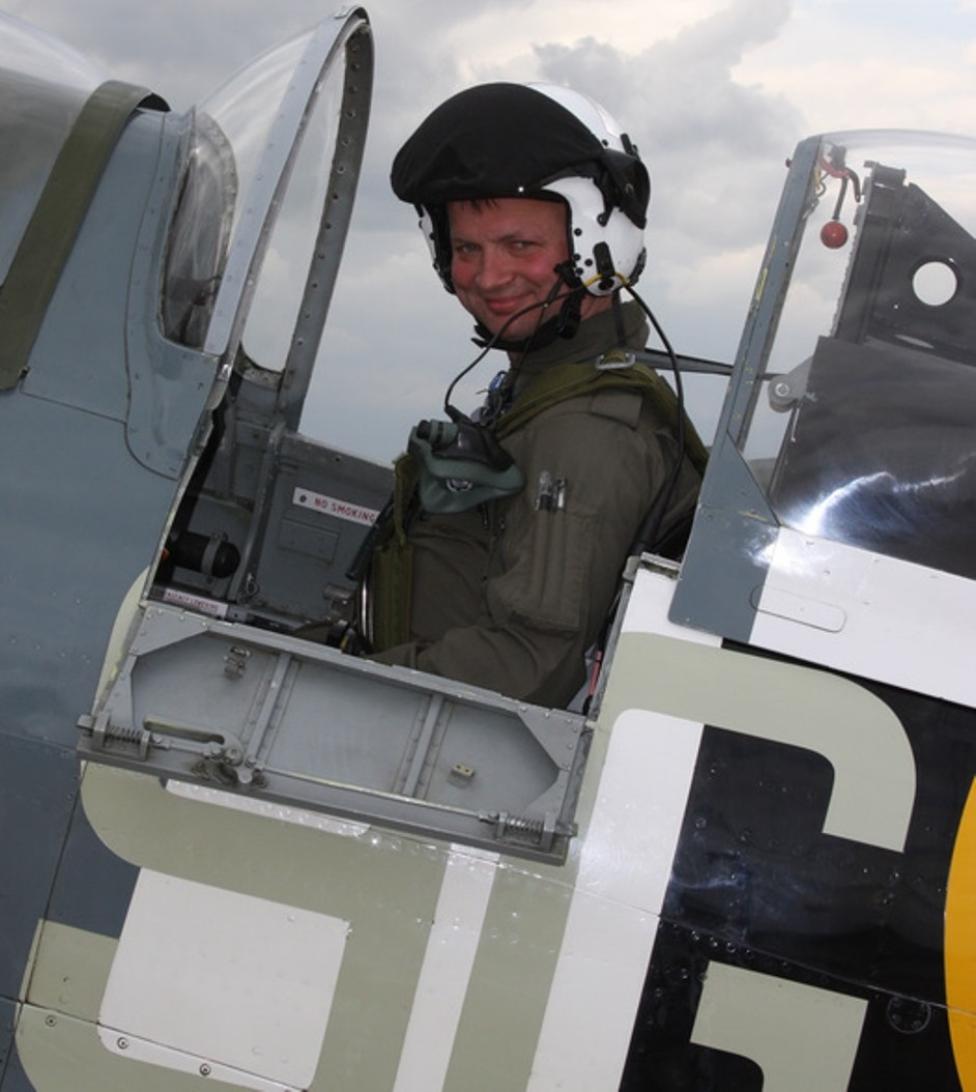
First Spitfire
over Poland
Jacek Mainka's road to the Spitfire cockpit followed the same path as wartime RAF pilots: Tiger Moth → Harvard → Spitfire. No shortcut — the same route, the same stages, the same preparation.
On 27 June 2014 he fulfilled a promise made to his grandfather — an RAF pilot. As the first Pole he flew a Spitfire over Poland, carrying a flag given by President Bronisław Komorowski.
To meet those men, to fly with them — it was worth all the effort, cost and responsibility of owning a warbird.
Jacek Mainka