Origins — Sir Geoffrey de Havilland
Geoffrey de Havilland — knighted as Sir Geoffrey — was born on 27 July 1882 in High Wycombe, west of London. At the age of 16 he designed and built his first aircraft — a small biplane powered by an engine he also designed himself. His grandfather gave Geoffrey £500 to finance the project. The aircraft broke apart just after taking off on its first flight — fortunately without injury to the designer-test pilot.
Geoffrey immediately set about building a second aircraft. His grandfather found more money, sensing something great in the young man's eccentric passion. He was right — his support directly contributed to the creation of England's most famous aircraft company and to the birth of the DH 2, 4 and 9, the Moths, the Dragon, the Mosquito, the Vampire, the Comet and the Trident.
In September 1910, his second, more successful design was flown. The aircraft was purchased by the Royal Aircraft Factory at Farnborough (designated F.E.1) and Geoffrey received his first job as a designer.
From 1914 to 1918, Geoffrey de Havilland worked for Airco as chief designer, creating the first true Royal Air Corps fighter, the DH-2, and the successful light bombers DH-4 (around 9,500 built in the US), DH-9 and DH-9A — all used extensively in WWI.
After the Great War — de Havilland company and a new market
In 1920 de Havilland founded De Havilland Aircraft Company Ltd. The new firm settled first at Stag Lane, then from 1934 at Hatfield in Hertfordshire. Post-war decline in military orders forced the company to search for a new source of income. The idea of an affordable aircraft emerged — to "create a market" for private owners. It had to be small, economical, simple to maintain, easy to hangar and forgiving to fly.
The first attempt was the DH-53 Humming Bird — a tiny, single-seat aircraft powered by a Douglas motorcycle engine, flown in 1923. It entered a government competition but was neither successful nor achieved the dream of "flying for everyone".
The key to success proved to be the right engine. Frank Halford, de Havilland's long-term collaborator, proposed building a new powerplant from half a Renault V8 from military surplus. In 1925 this produced the 4-cylinder Cirrus I of 60 hp, followed soon by the 80 hp Cirrus II. These were at last sufficiently powerful and reliable.
The Moth's success — records and popularising aviation
The DH-60 Moth prototype, flown by de Havilland himself on 22 February 1925, was a "scaled-down DH-51" with simple wooden construction. It was an immediate success — the British aviation authorities ordered 90 examples to support the newly formed flying clubs.
Thanks to the Moth series, the company that employed 300 people in 1924 had 1,500 staff and was producing 16 Moths a week by 1929. The DH-60 cost £650 in 1929, when a popular car cost about £200. Flying became fashionable — the Prince of Wales, later King Edward VIII, qualified in 1929 and began flying solo.
In May 1930, Amy Johnson flew solo in a DH-60G G-AAAH "Jason" from England to Australia in a record 19 days. Halford-de Havilland Gipsy engines powered aircraft from many manufacturers — including Poland's RWD, PWS, PZL and Bartel.
RAF competition — birth of the Tiger Moth
In the early 1930s the RAF launched a competition for a standard training aircraft — cheap and simple to operate. De Havilland entered with the Moth Trainer DH-60T, powered by a new Gipsy III with inverted cylinders. This layout, proposed by Halford, eliminated the problem of the engine "spitting oil and fumes in the faces of aviators" with conventional upright cylinders.
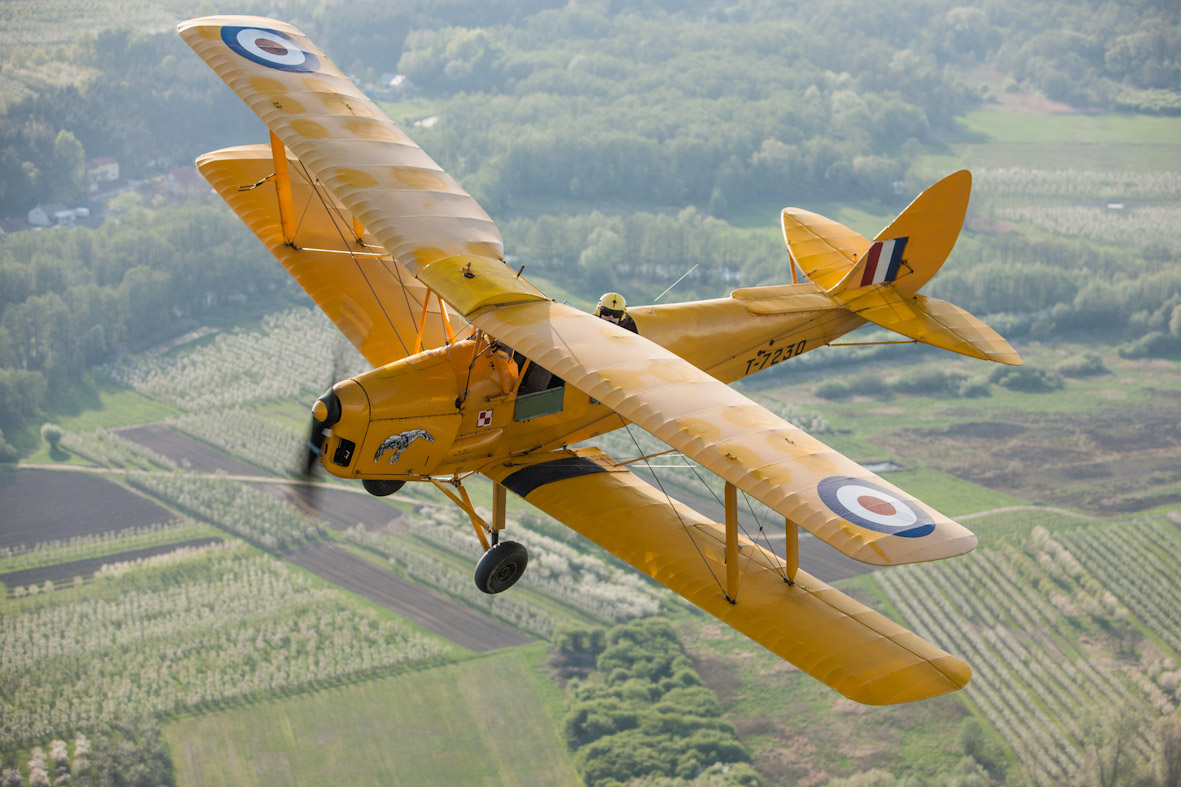
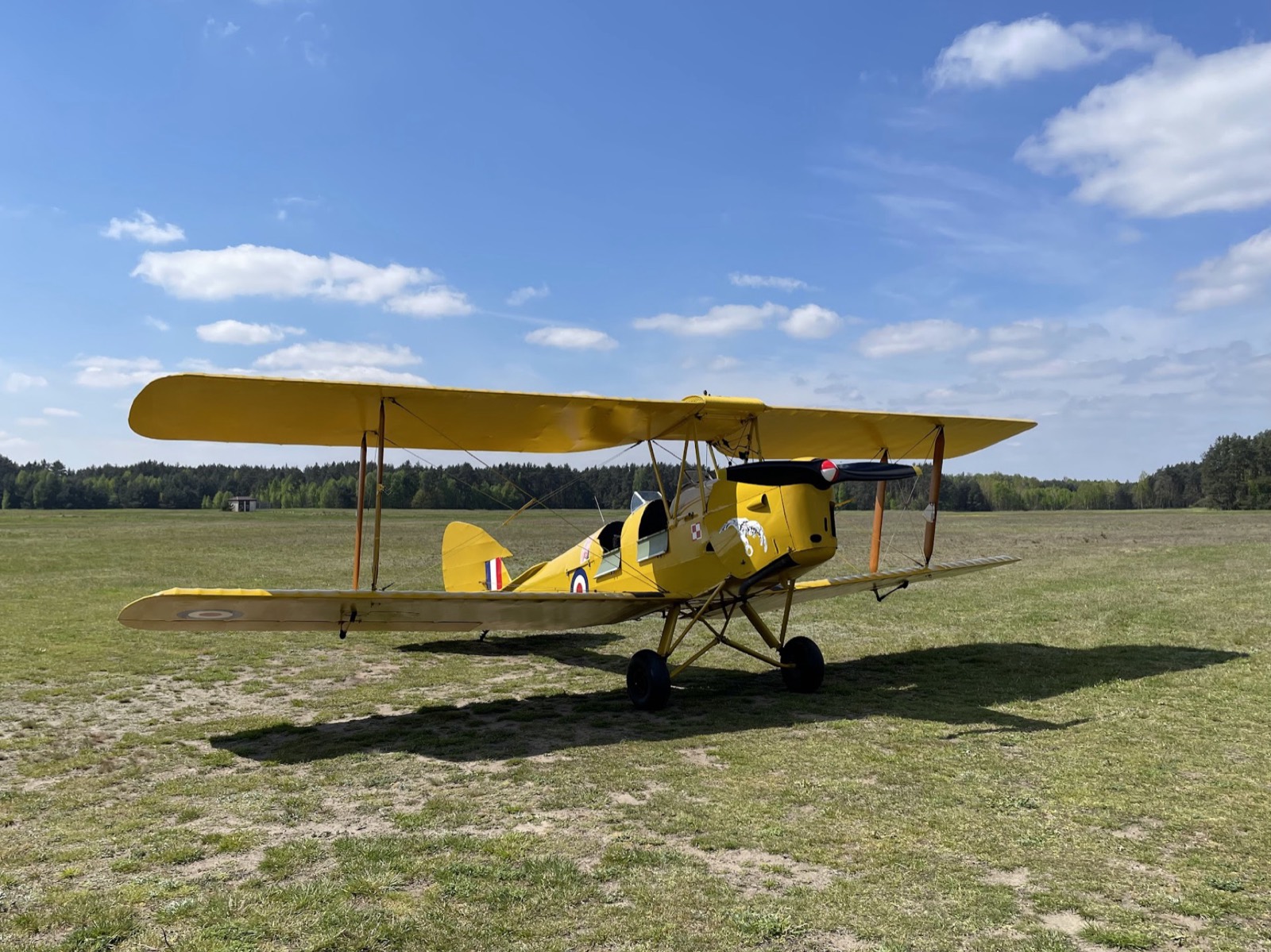
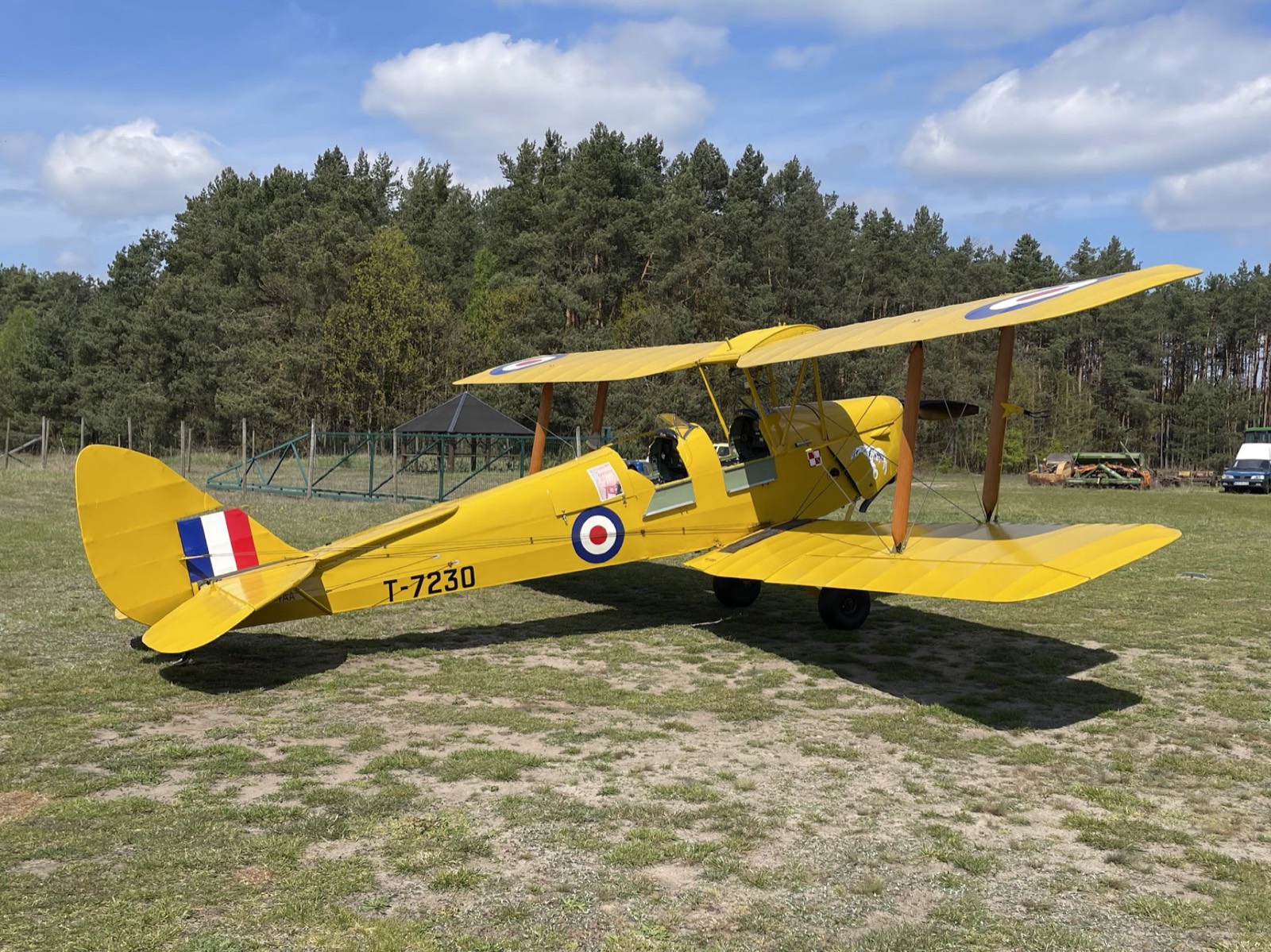
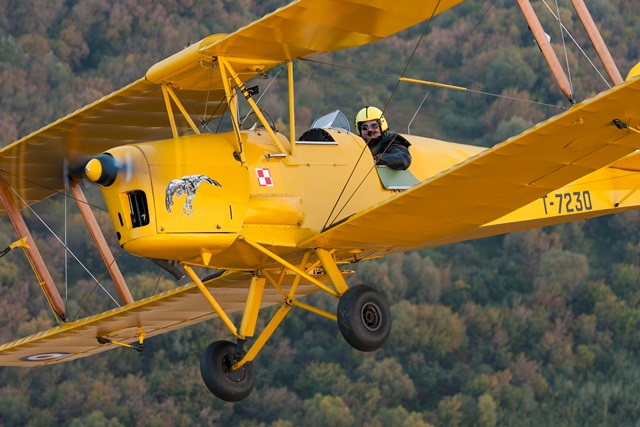
RAF test pilots initially rejected the design — they felt that the proximity of the upper wing and its fuel tank directly above the instructor would make parachute escape too difficult. The designer moved the upper wing forward by 56 cm and introduced stagger, plus significant dihedral on the lower wings. These modifications changed the silhouette enough to earn a new designation — DH-82.
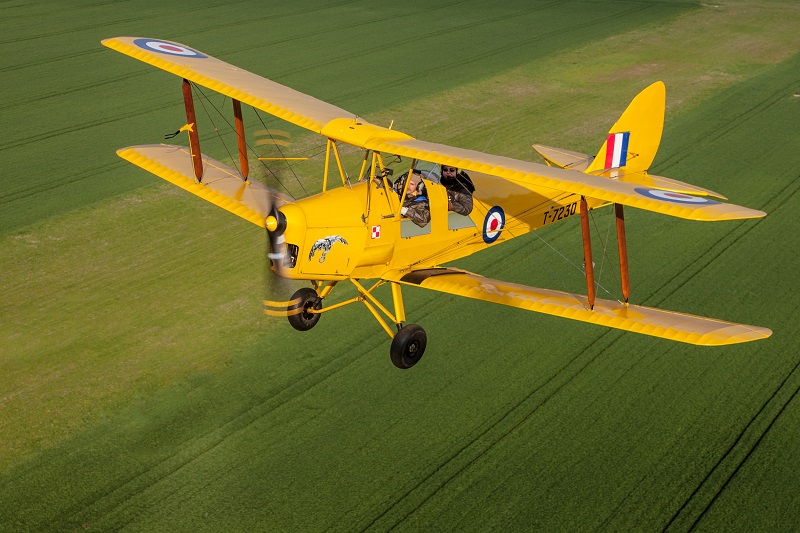
The prototype G-ABRC, flown on 26 October 1931 by Hubert Broad, was the first "Tiger Moth". In 1933 the design was refined with a new DH Gipsy Major I engine (130 hp), giving birth to the DH-82A Tiger Moth II — in series production from 1933 until 15 August 1945.
Polish Moths and Tiger Moths — before and during the war
The first Moth arrived in Poland in early September 1928 and was operated by the Training Squadron of the 1st Air Regiment in Warsaw. In all, eight DH-60s of various versions passed through the Polish civil register.
In 1940, Polish pilots in Britain encountered the DH-82A again. To meet the rapidly growing demand for pilots in the Polish Air Force, the 25th Polish Elementary Flying Training School (25 EFTS) was established in Peterborough in May 1941. By the end of WWII, a total of 1,665 Polish pilots completed initial training on Tiger Moths.
1940–1945 — wartime production and service
At the start of the war, DH-82A production moved from DH's Hatfield plant to Morris Motors Ltd in Cowley, near Oxford. The car company reorganised the Tiger Moth production process — Morris Motors built 3,508 examples at a rate of 35–40 aircraft per week.
Most basic training in the United Kingdom during the war was conducted on Tiger Moths. The Empire Air Training Scheme required that a 20-year-old boy be prepared to command a complex heavy bomber within a year. The first element was a 12-week basic course — if a candidate could learn to fly the Tiger Moth safely, he could proceed.
When the threat of invasion hung over the British Isles in 1940, attempts were made to arm the Tiger Moth. The "Paraslasher" project involved installing a 2.5-metre pole with a scythe under the fuselage to cut parachute lines. The "Banquet Light" project envisaged simple racks for 10–12 kg bombs — 1,500 sets were produced, a testament to ingenuity after the Dunkirk disaster.
From 1931 to 1945, around 9,000 Tiger Moths of all variants were produced. Beyond Britain (5,483 examples), large numbers were built in Canada (over 1,700), Australia and New Zealand.
Post-war — collectors and The Moth Club
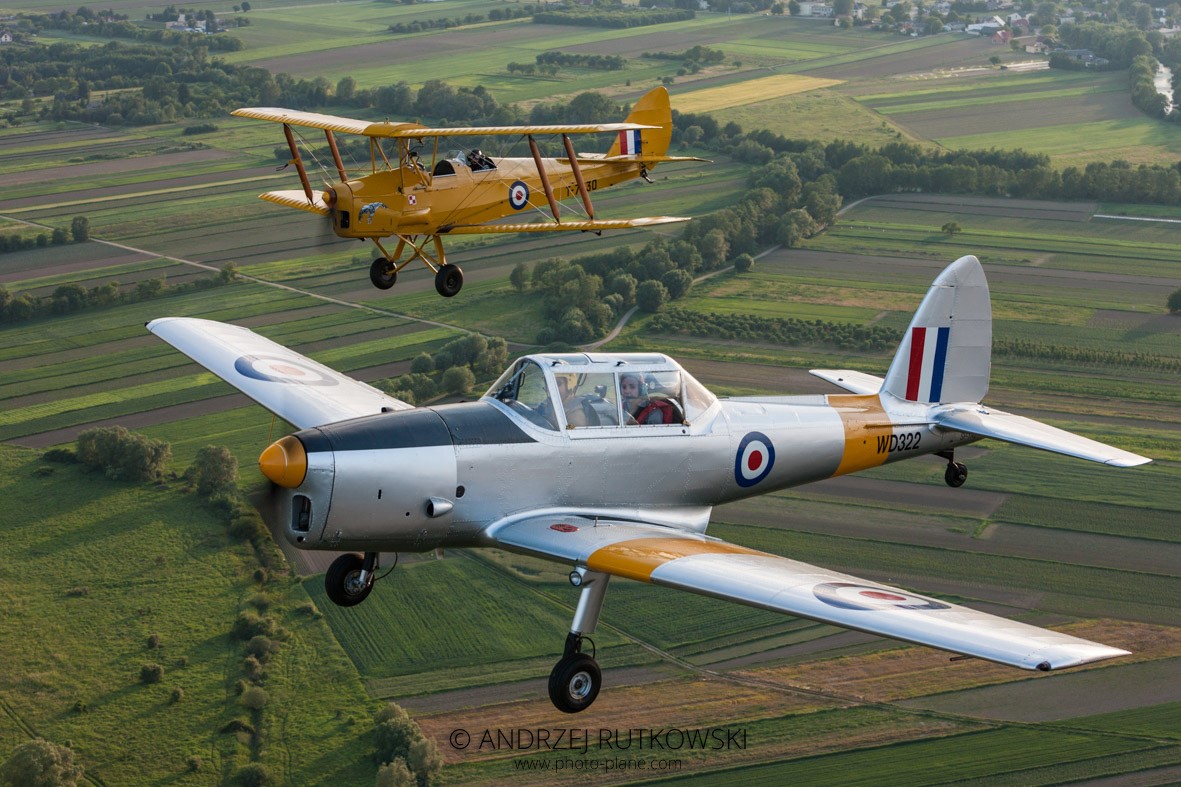
Tiger Moths were replaced in RAF service (around 1955) by all-metal low-wing de Havilland Canada DHC-1 Chipmunks, designed by Wsiewołod Jakimiuk — the pre-war PZL fighter designer.
Stuart McKay devoted many years to restoring his Tiger Moth G-AZZZ, which led in 1975 to the creation of the de Havilland Moth Club — an organisation that has organised annual rallies and ensured the continued production of hard-to-find spare parts. Thanks to this club, hundreds of Tiger Moths still fly worldwide.
In 2005 there were still 933 aircraft on registers worldwide — of which approximately 200–250 were believed to be airworthy.